In a report published on November 11, 2026, writer ross.wei described Tacit Chain as a payment-focused zk-rollup prototype intended to make a purchase visible to a merchant quickly while keeping payment details private. The article presents a coffee purchase as its test case, but its performance and security claims are the author’s descriptions, not independently verified results.

From sender to merchant
Under the described design, a sender’s device generates a proof that a payment is valid without revealing the sender, recipient or amount to the rollup verifier. A second proof checks the processed batch before it is accepted on Ethereum. A rotating leader orders payments and submits batches to the TacitBlocks.sol contract, which checks validity and records blocks for withdrawals.
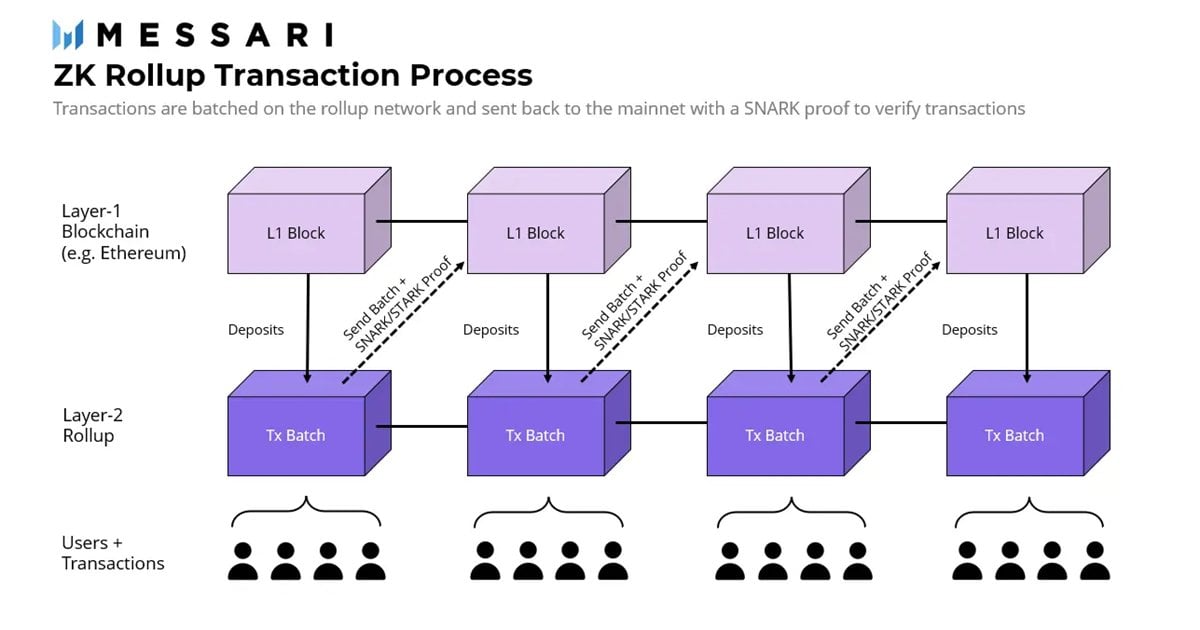
The author says a merchant can see receipt when the customer sends a payment, with Ethereum finality roughly one minute later. A possible reduction toward 30 seconds is presented as a future improvement dependent on stronger participation and proving capacity—not a guaranteed checkout time.
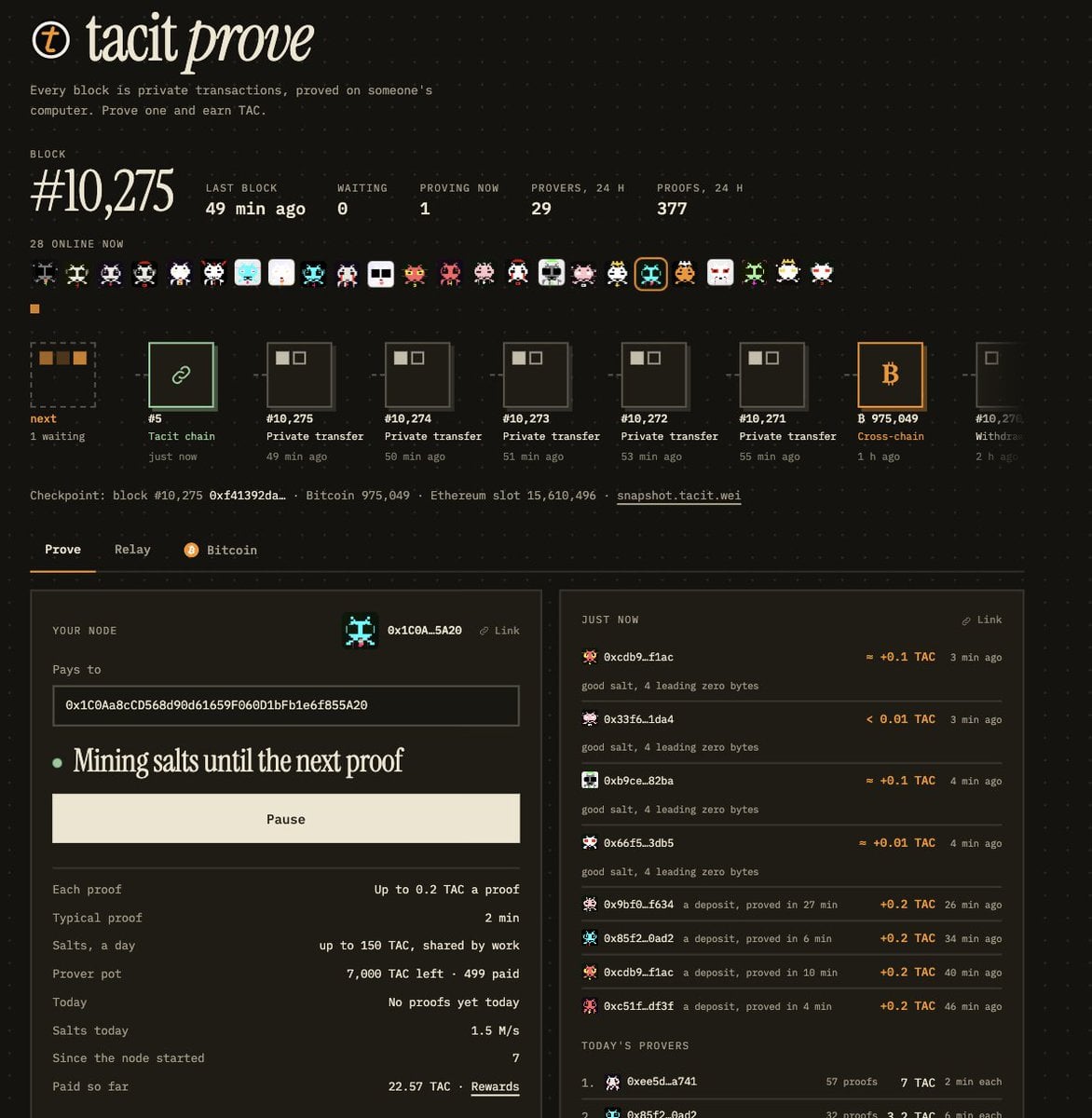
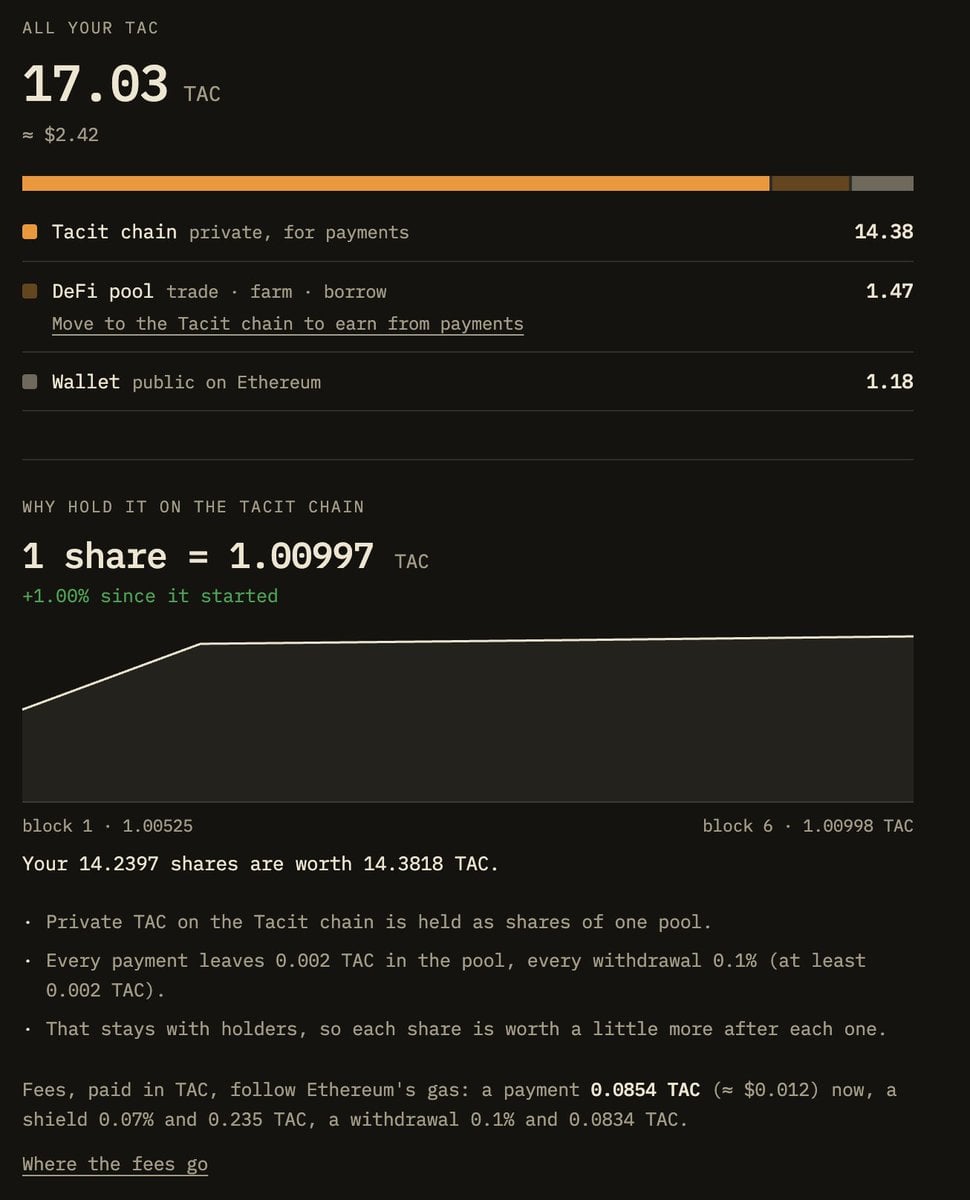
Fees are paid in TAC, which the article also describes as the rollup’s currency. It says users can enter from Ethereum or use a Bitcoin bridge; the proposed fast Bitcoin route involves an atomic swap with a liquidity provider. Those are distinct steps from the private payment itself. A merchant wishing to receive another asset would still need to withdraw or exchange TAC through the routes described in the article.
Availability and exit constraints
Holding a 1,000 TAC seat qualifies a participant for a scheduled leader turn, according to the report. If that leader does not submit a block, anyone can take over after 10 minutes. This fallback does not mean every payment is guaranteed immediate inclusion.
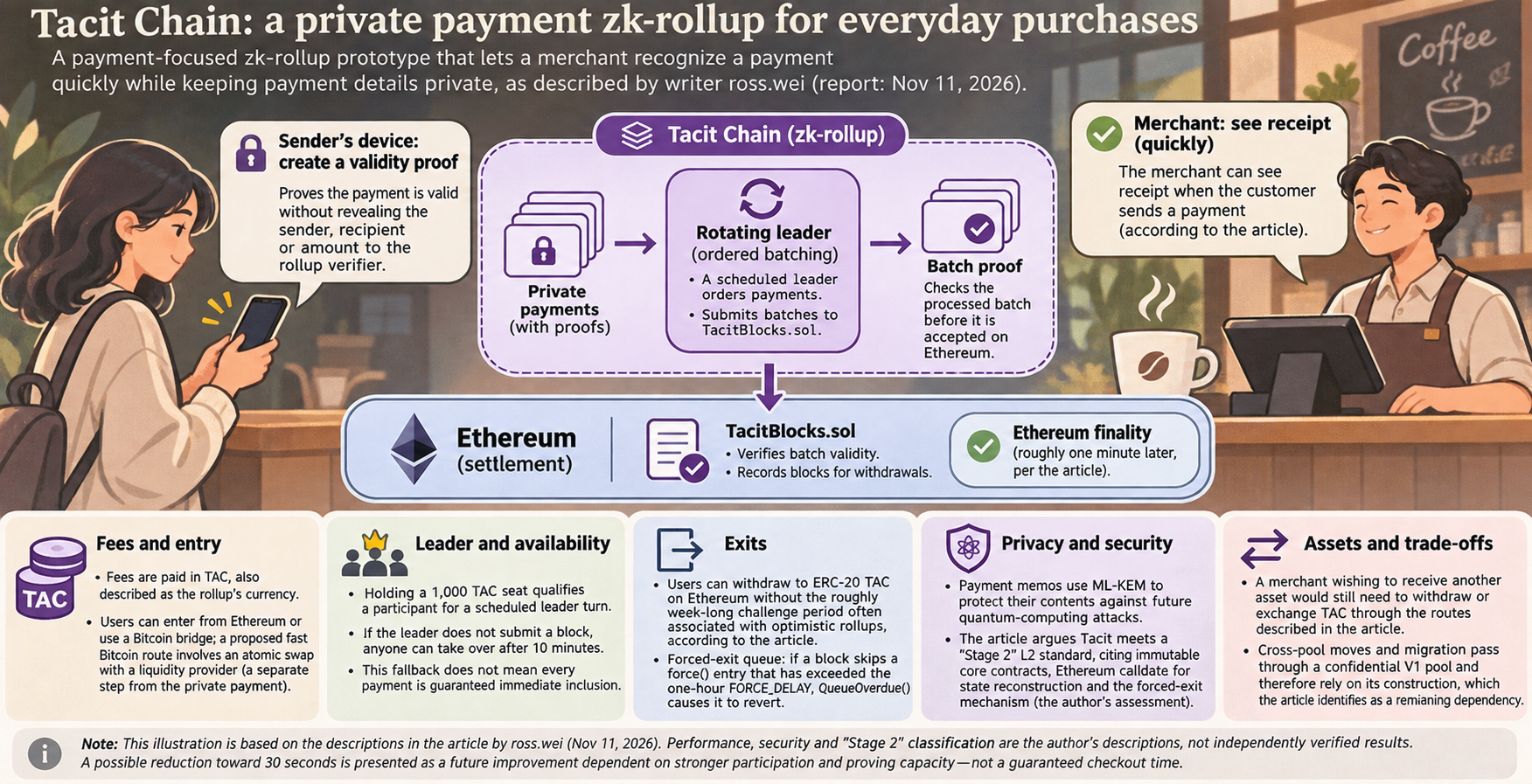
The author contrasts Tacit’s proposed exits with the roughly week-long challenge period often associated with optimistic rollups. The article says users can withdraw to ERC-20 TAC on Ethereum without that wait. It also describes a forced-exit queue: if a block skips a force() entry that has exceeded the one-hour FORCE_DELAY, QueueOverdue() causes it to revert. Moving onward to Bitcoin is a separate bridge step, not the same as an Ethereum withdrawal.
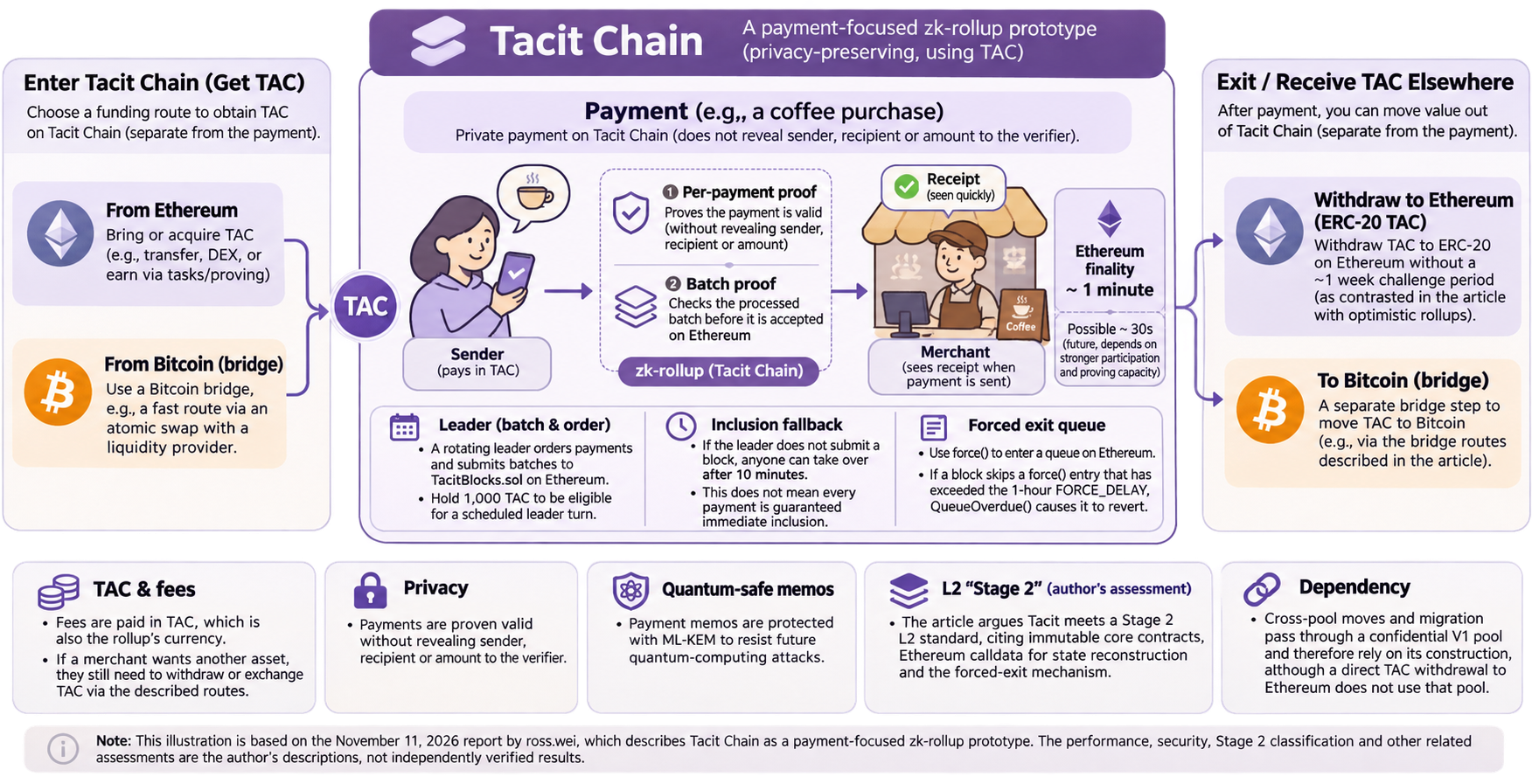
The article says payment memos use ML-KEM to protect their contents against future quantum-computing attacks. It also argues that Tacit meets a “Stage 2” L2 standard, citing immutable core contracts, Ethereum calldata for state reconstruction and the forced-exit mechanism. That classification is the author’s assessment. The report identifies a remaining dependency too: cross-pool moves and migration pass through a confidential V1 pool and therefore rely on its construction, although it says a direct TAC withdrawal to Ethereum does not use that pool.
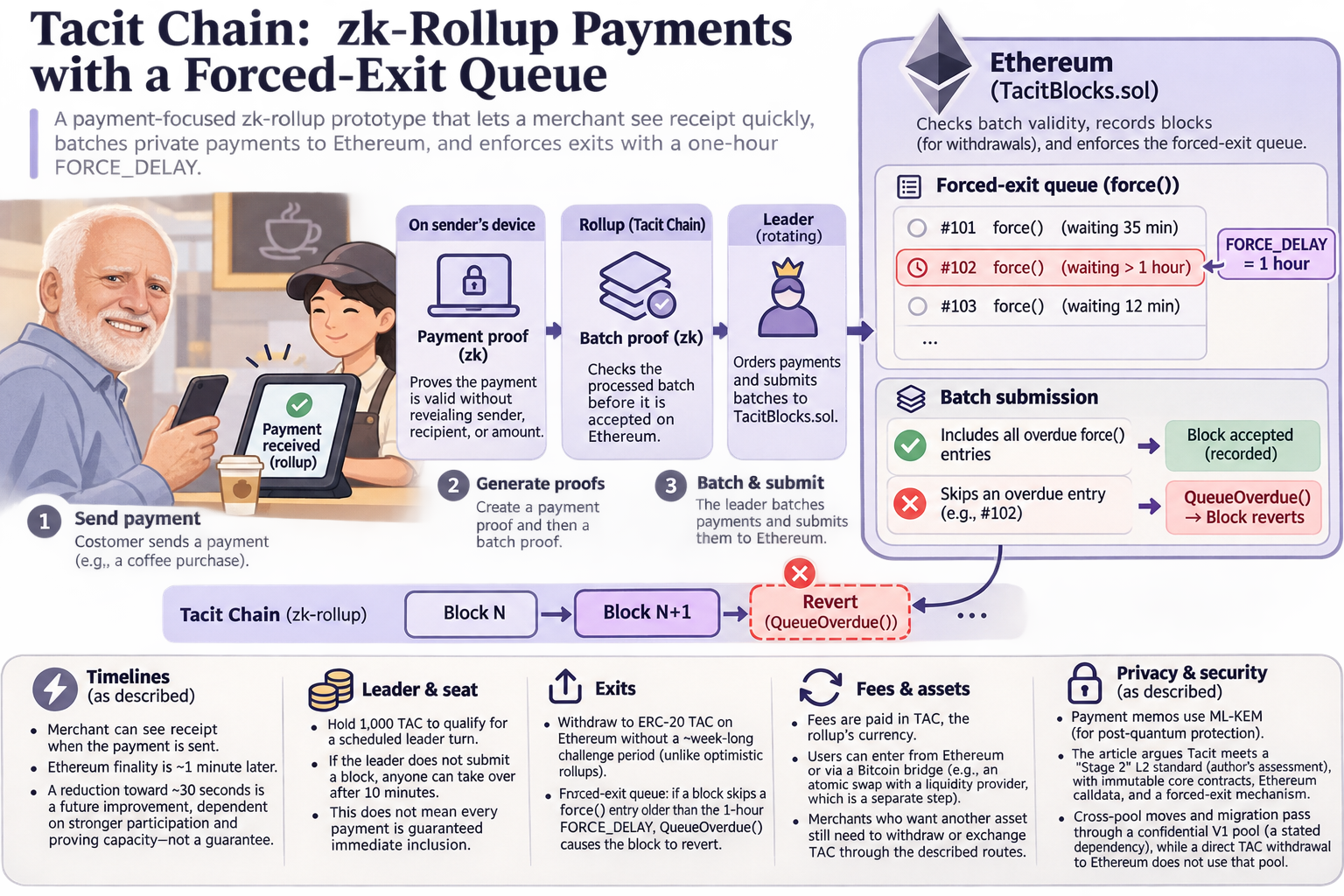
Tacit’s proposal addresses a payment friction—letting a merchant recognize a payment before its Ethereum batch reaches finality—through a rollup rather than a Lightning channel. Its practical trade-offs include TAC-denominated fees, proving and batch submission, and additional exchange or bridge steps when sender and receiver do not want to use TAC.