
An analysis published on November 18, 2026, examined a problem for crypto payment providers: a group may have regulatory registrations, authorizations and licensed partners, yet still lack a workable path from a customer’s stablecoin to a merchant’s bank account. The test is not how many licenses the group lists, but which entity handles each step and what happens if the payment fails.
Follow the payment from customer to merchant
Consider a business paying a European supplier. It signs up with a platform, completes business identity checks and sends stablecoins to a designated wallet. The stablecoins are exchanged, and a payment partner sends euros to the supplier’s bank account.
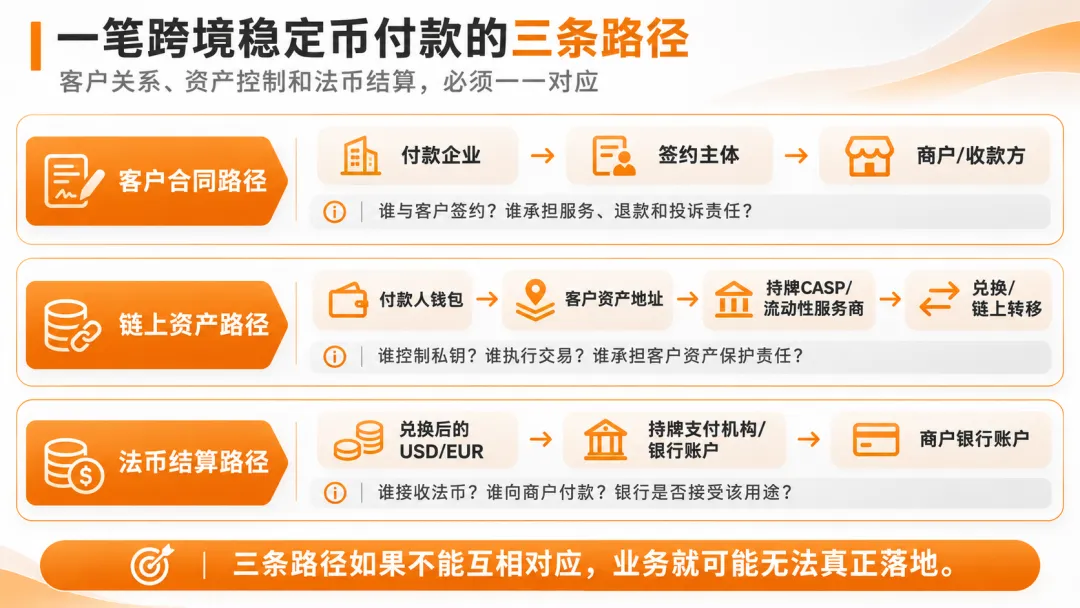
That apparent single payment contains three paths the provider needs to reconcile:
- Customer relationship: Which company contracts with the payer, what service does it provide, and who handles complaints and refunds?
- Asset control: Who controls the wallet keys, decides when to execute the transfer, and is responsible for protecting customer assets?
- Fiat funds: Whose account receives the proceeds of conversion, is that account approved for those funds, and who pays the supplier?
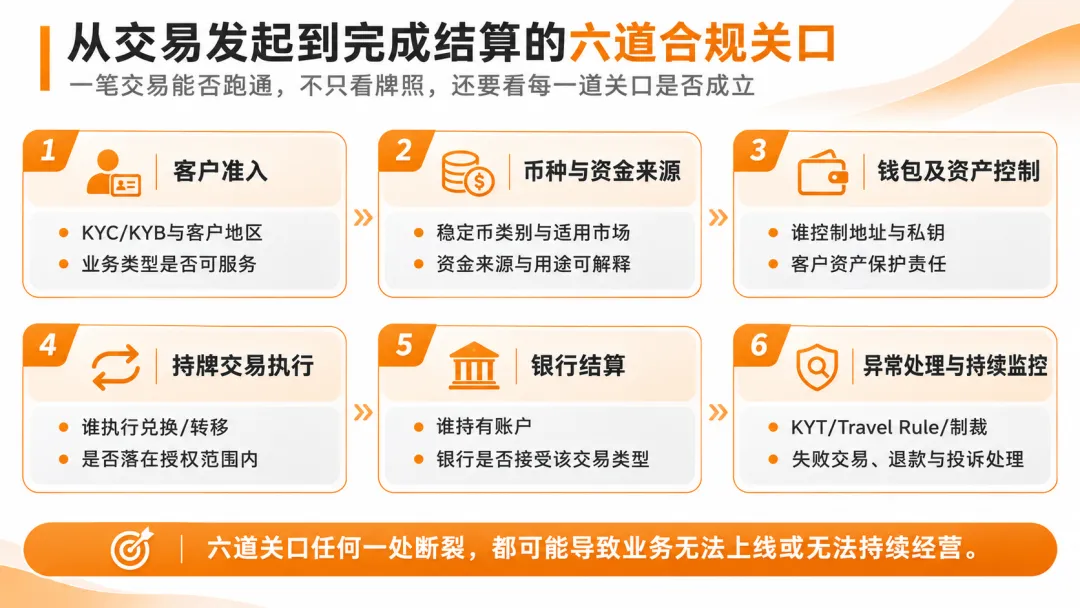
A contract describing one company as a technology provider does not settle the question if that company actually receives customer funds and directs transactions. Likewise, a license held elsewhere in the group does not automatically cover the entity performing a regulated step.
Authorization, bank access and partner responsibilities differ
The analysis distinguishes several limits. A US FinCEN money services business registration is not a nationwide money-transmission license; state law still matters. An EU crypto-asset service provider (CASP) can use MiCA passporting after the required cross-border notification, but only for services within its existing authorization. Passporting does not itself grant the full powers of a payment institution or electronic-money institution. The analysis also notes that an EBA transition period concerning the interaction of MiCA and PSD2 ended on March 2, 2026; some services involving electronic-money token transfers and custodial wallets may also need to address payment-service authorization.
Bank access is a separate constraint. An account approved for a company’s operating expenses is not necessarily approved to collect payments from multiple third-party customers. Even where a provider has a license and a fiat-payment partner, the bank must be able to assess the account’s purpose, the origin of funds and the underlying transactions. The analysis notes the EBA’s position that institutions should assess actual customer risk rather than exclude entire categories without sufficient grounds, while still meeting anti-money-laundering obligations.
Partners can divide wallet, identity-checking, exchange and fiat-payment work, but the division needs to function when something goes wrong. If an on-chain address triggers a risk alert, the parties need to know who may pause the transaction, contact the customer, investigate and arrange a refund. Under MiCA Article 73, outsourcing operational functions does not transfer a CASP’s regulatory responsibilities or change its relationship with customers or authorization conditions.
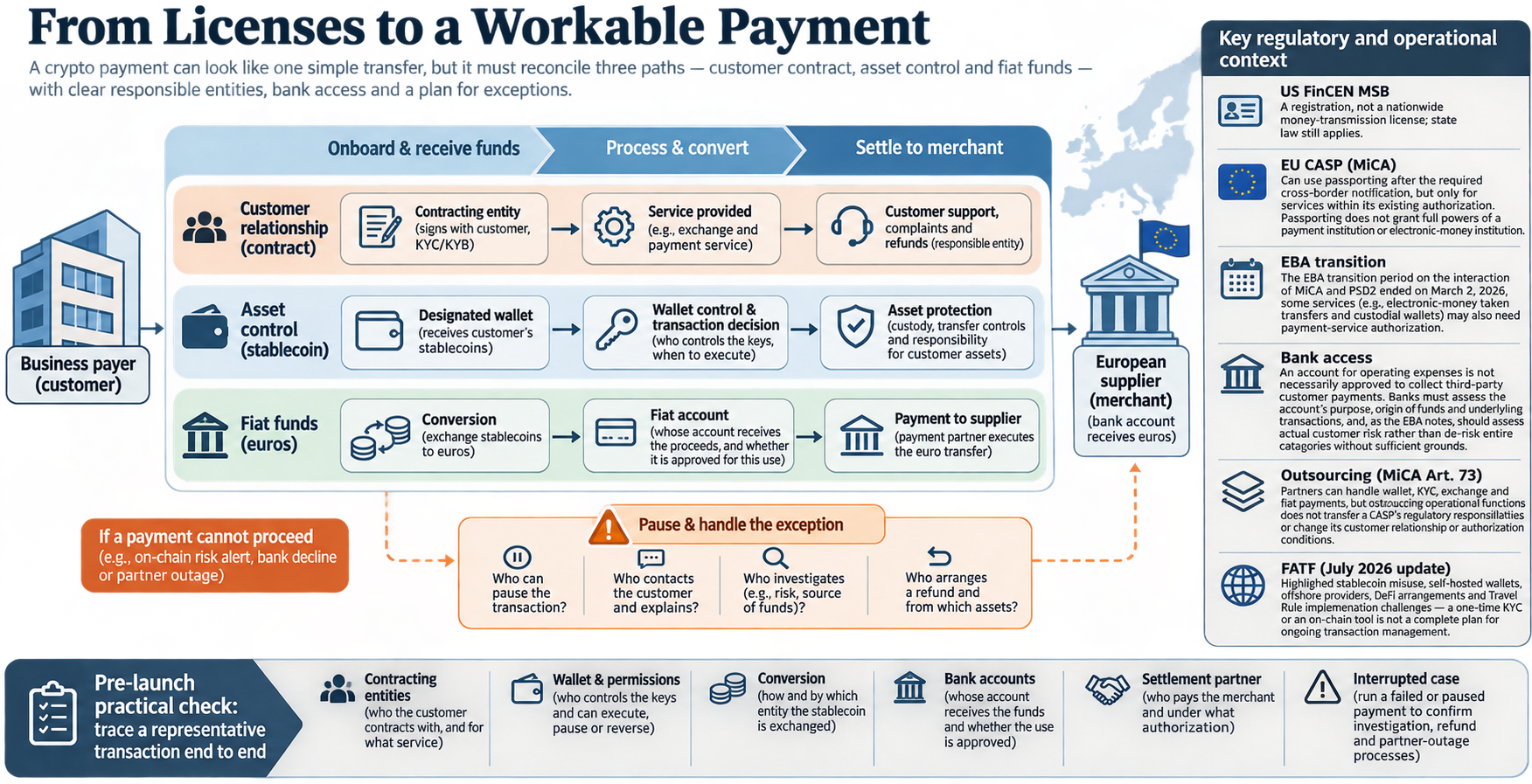
The analysis also cites FATF’s July 2026 update on virtual-asset regulation, which highlighted stablecoin misuse, transactions involving self-hosted wallets, offshore providers, DeFi arrangements and difficulties implementing the Travel Rule. Its point for payment operators is that a one-time identity check or an on-chain monitoring tool is not a complete plan for handling transactions over time.
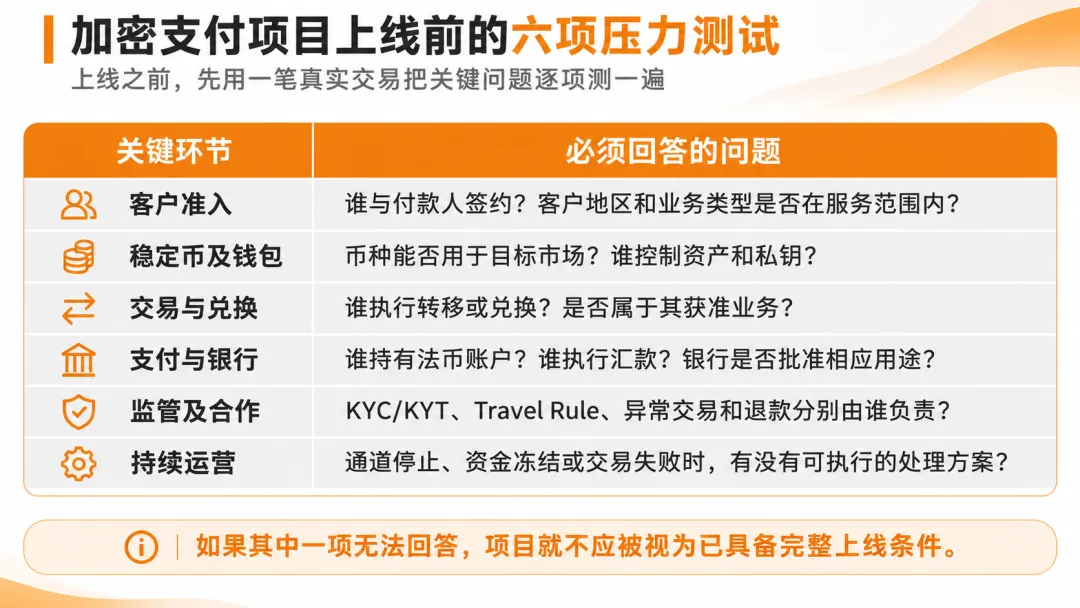
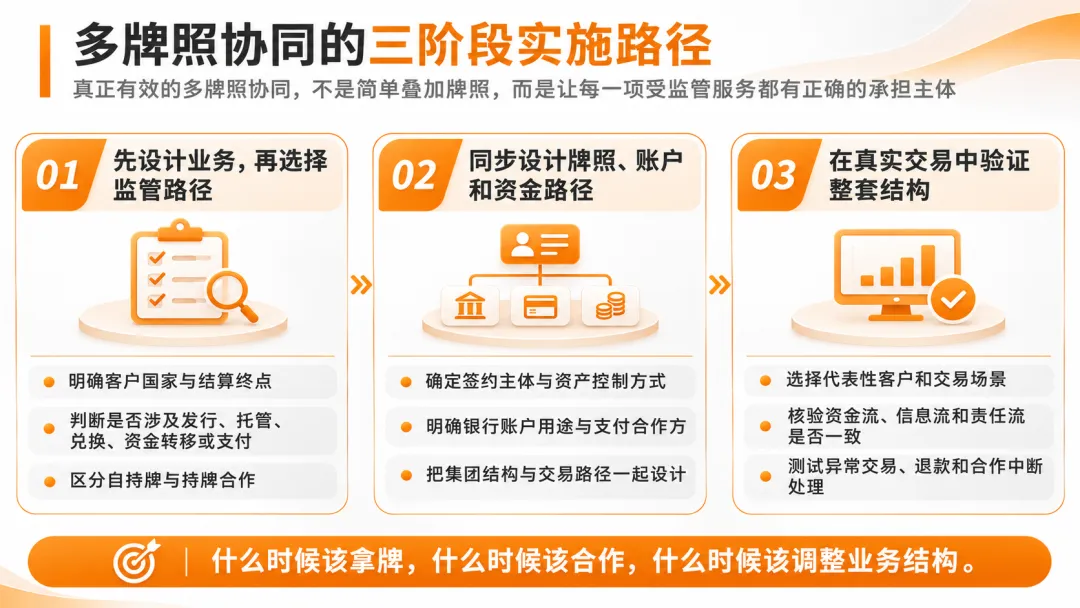
Before scaling a payment service, the proposed practical check is to trace a representative transaction—including an interrupted one—through the contracting entities, wallet permissions, conversion, bank accounts and settlement partner. That exposes gaps a further license alone may not fix: an unsuitable account, unclear control of customer assets, missing transaction data or no agreed process for refunds and partner outages.