In a report dated November 18, 2026, TechFlow said the World Bank Group had announced a collaboration with Citi and Circle to explore using USDC and blockchain networks alongside existing cross-border development-aid payment systems. The proposed pilot is not a switch of all aid payments to stablecoins. According to the report, initial work would be limited to borrowing countries where digital-asset use is legally permitted.
The payment path under examination would connect conventional bank transfers to on-chain settlement. TechFlow said Circle would provide the USDC infrastructure, while Citi would work on the connection between banking rails and the blockchain network. Licensed financial institutions would participate in testing how that model could connect with central-bank and local-bank systems. The World Bank Group would assess whether to bring more commercial banks into the clearing network later.
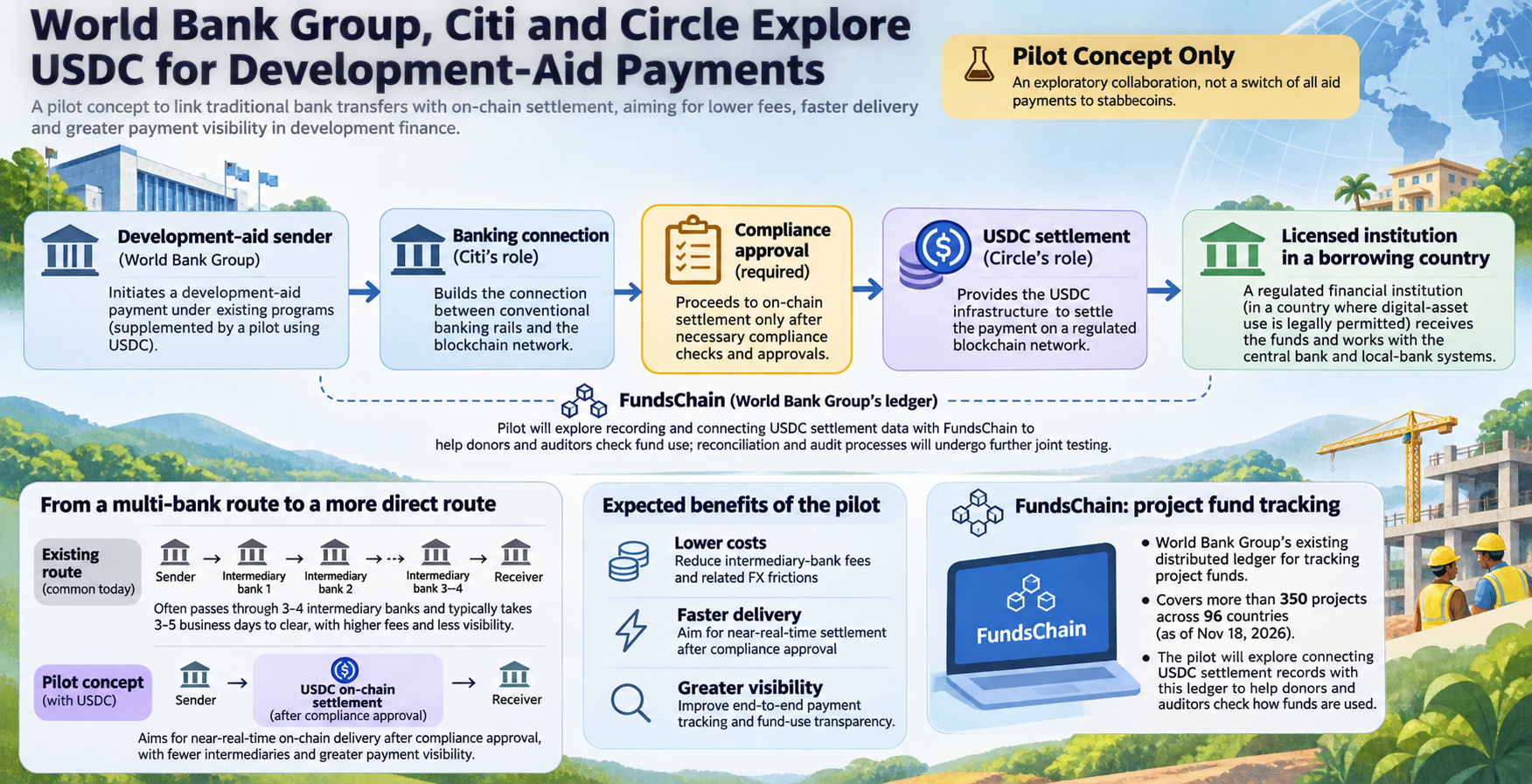
The aim is to reduce intermediary-bank fees, time spent in transit and gaps in payment visibility. TechFlow described existing transfers as sometimes passing through three or four intermediary banks and typically taking three to five business days to clear. It presented near-real-time on-chain delivery after compliance approval as a goal of the pilot, not an established result.
The report also linked the proposed USDC work to FundsChain, the World Bank Group’s existing distributed ledger for tracking project funds. It said FundsChain covered more than 350 projects across 96 countries as of November 18, 2026. Connecting stablecoin settlement records with that ledger could help donors and auditors check how funds are used, but the report described reconciliation and audit processes as subjects for further joint testing.