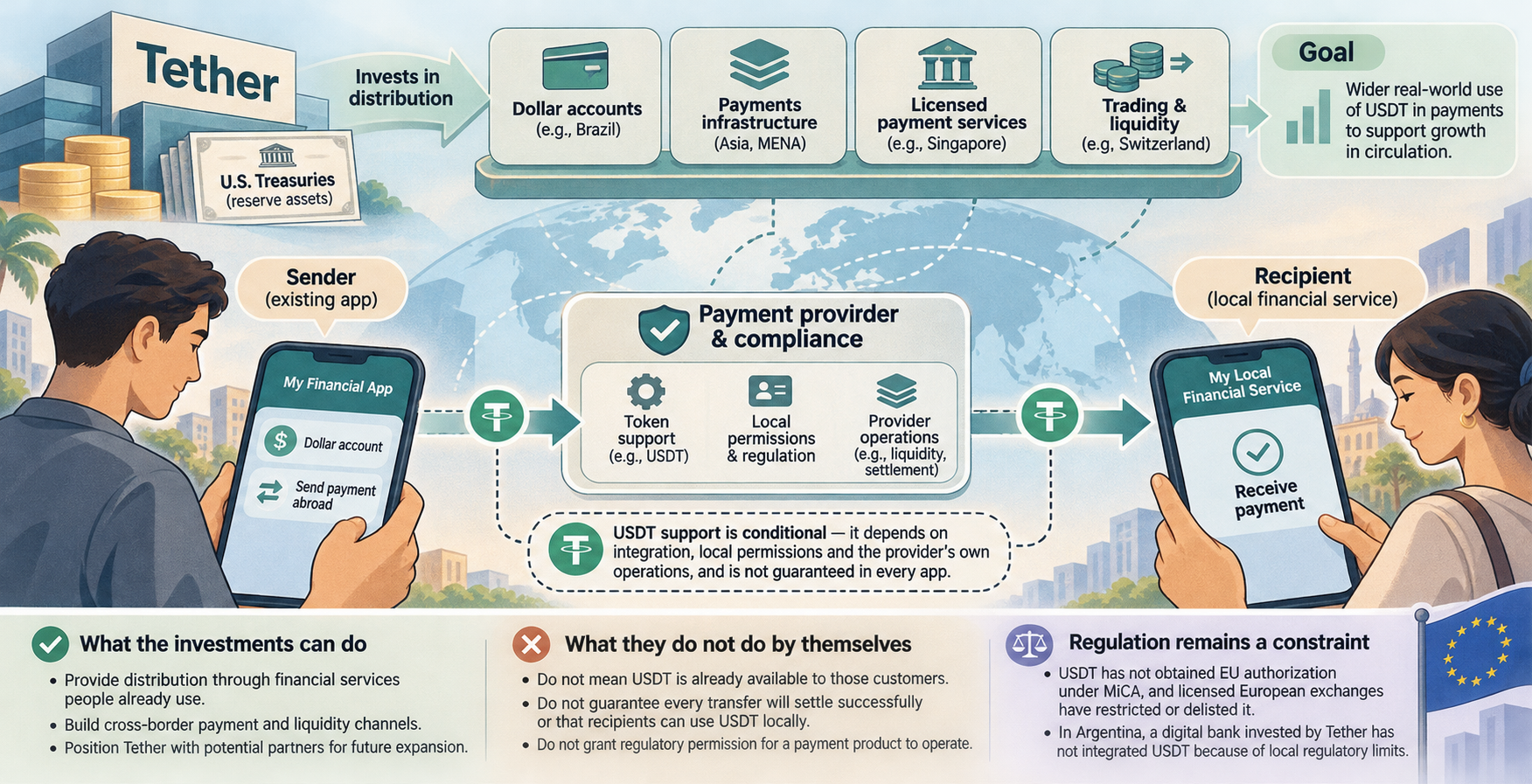
As reported on November 21, 2026, Tether had backed four companies between November 16 and 19 whose businesses touch cross-border dollar access, payments or stablecoin liquidity. The investments point to a strategy of reaching customers through existing financial services rather than requiring them to adopt a new wallet. They do not, by themselves, mean USDT is available to those customers.
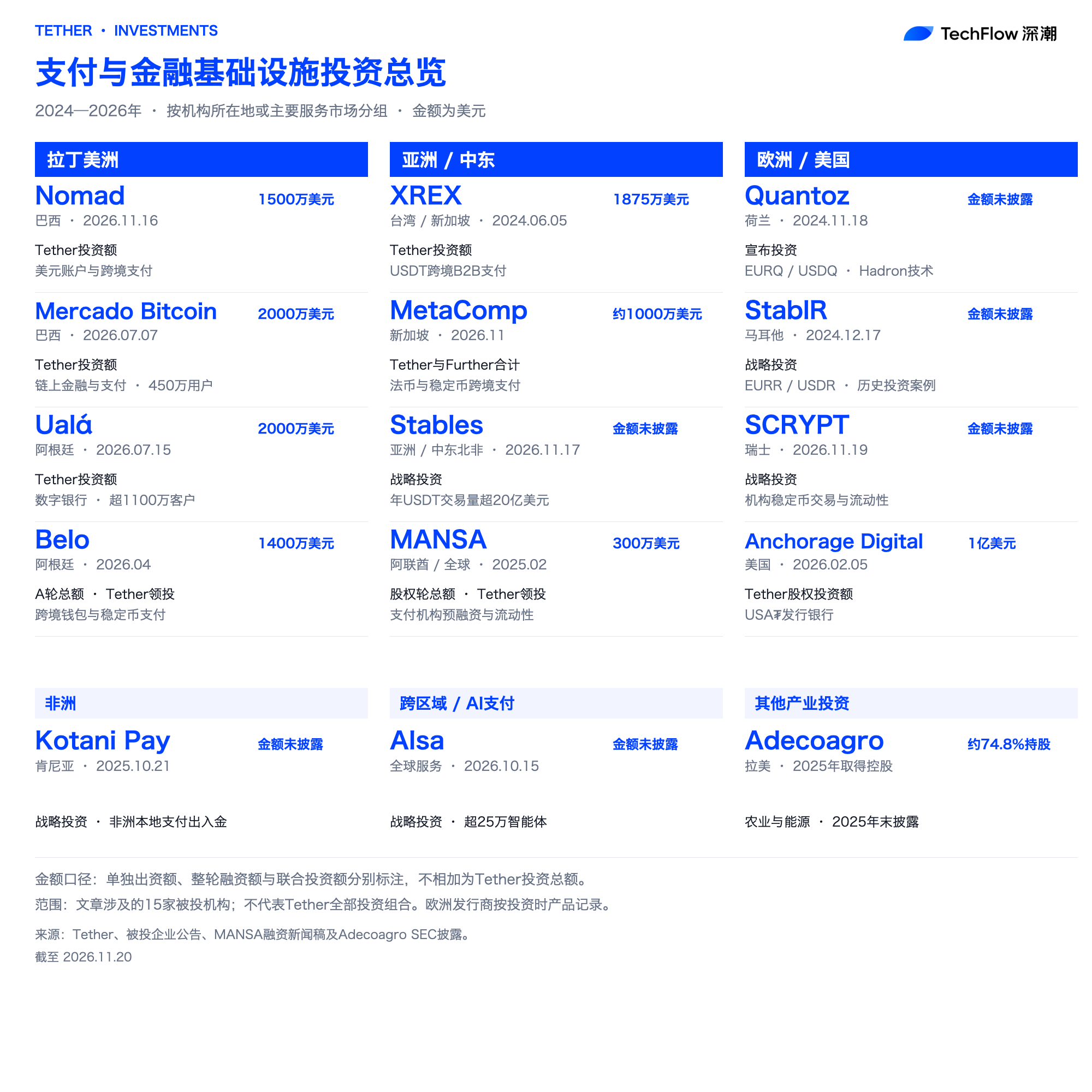
Four investments, different routes
In Brazil, Tether Capital led a Series C round for dollar-account provider Nomad, contributing $15 million. The round totaled 172 million reais and valued Nomad at 4 billion reais after the investment. Nomad had 3.8 million customers and managed about 8 billion reais in assets, but integration of USDT and Tether’s gold token XAUT was still being explored, with no launch date announced.
Tether also invested in Stables, a payments-infrastructure company processing more than $2 billion in USDT transactions annually and focused on Asia and the Middle East and North Africa. In Singapore, Tether and Abu Dhabi-based Further Asset Management invested about $10 million combined in MetaComp; the funding was intended to expand its compliance and cross-border channels. The fourth investment was in Swiss stablecoin trading and liquidity provider SCRYPT. The original report did not give investment amounts for Stables or SCRYPT.
For a customer, an existing app could provide a familiar way into a dollar payment service. But an investment is not a working payment route: token support, local permissions and the provider’s own operations still determine what a sender and recipient can actually use.
Why Tether is pursuing distribution
Tether reported $191.5 billion in reserve assets, including $132.4 billion in U.S. Treasury exposure, as of September 30, 2026. It reported $4.5 billion in net operating profit for the first nine months of the year. The original report contrasted that with more than $10 billion in net profit for the comparable period of 2025, while noting that the two profit measures are not directly comparable. It also said USDT issuance had remained around $184 billion through the first three quarters of 2026.
The report’s interpretation is that, with interest rates outside Tether’s control, wider use of USDT in payments could support growth in circulation. Earlier investments included XREX for compliant cross-border business payments and MANSA, which provides USDT pre-funding liquidity to payment companies. Those arrangements address different parts of a payment journey; neither establishes that every transfer will settle successfully or that recipients can use USDT locally.
Regulation remains a constraint. The report said USDT had not obtained EU authorization under MiCA and that licensed European exchanges had restricted or delisted it. It also noted that Argentine digital bank Ualá, despite Tether’s investment, had not integrated USDT because of local regulatory limits. Ownership stakes can give Tether potential distribution partners, but they cannot grant permission for a payment product to operate.