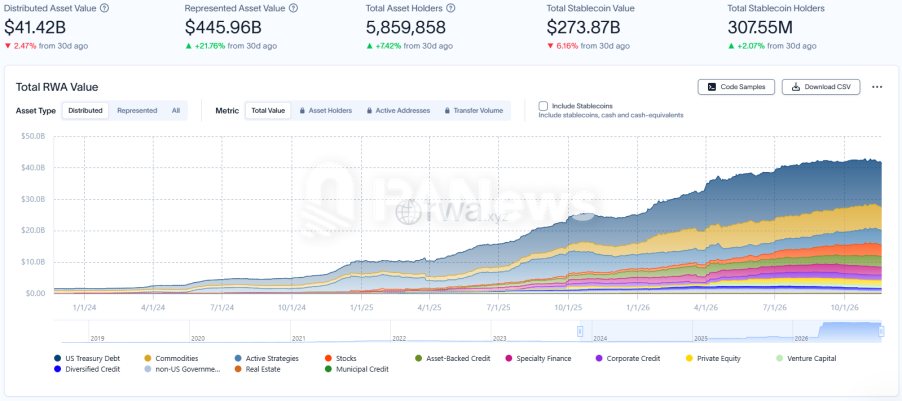
A weekly RWA review published on November 20, 2026, covering November 13–20, described several efforts to connect tokenized deposits, stablecoins and existing payment systems. Some were completed tests; others remained proposals or planned services.
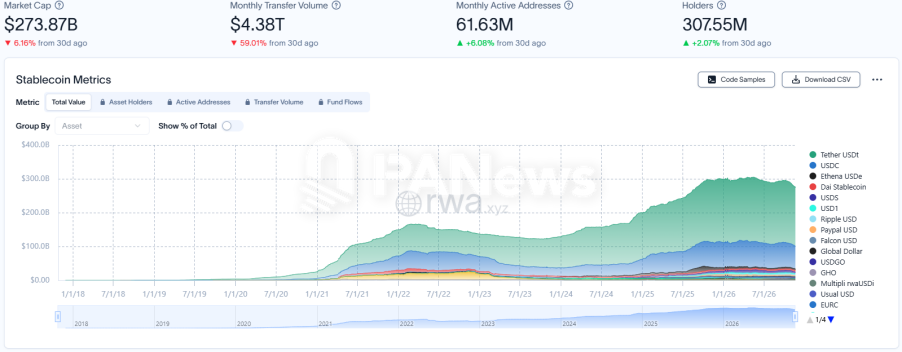
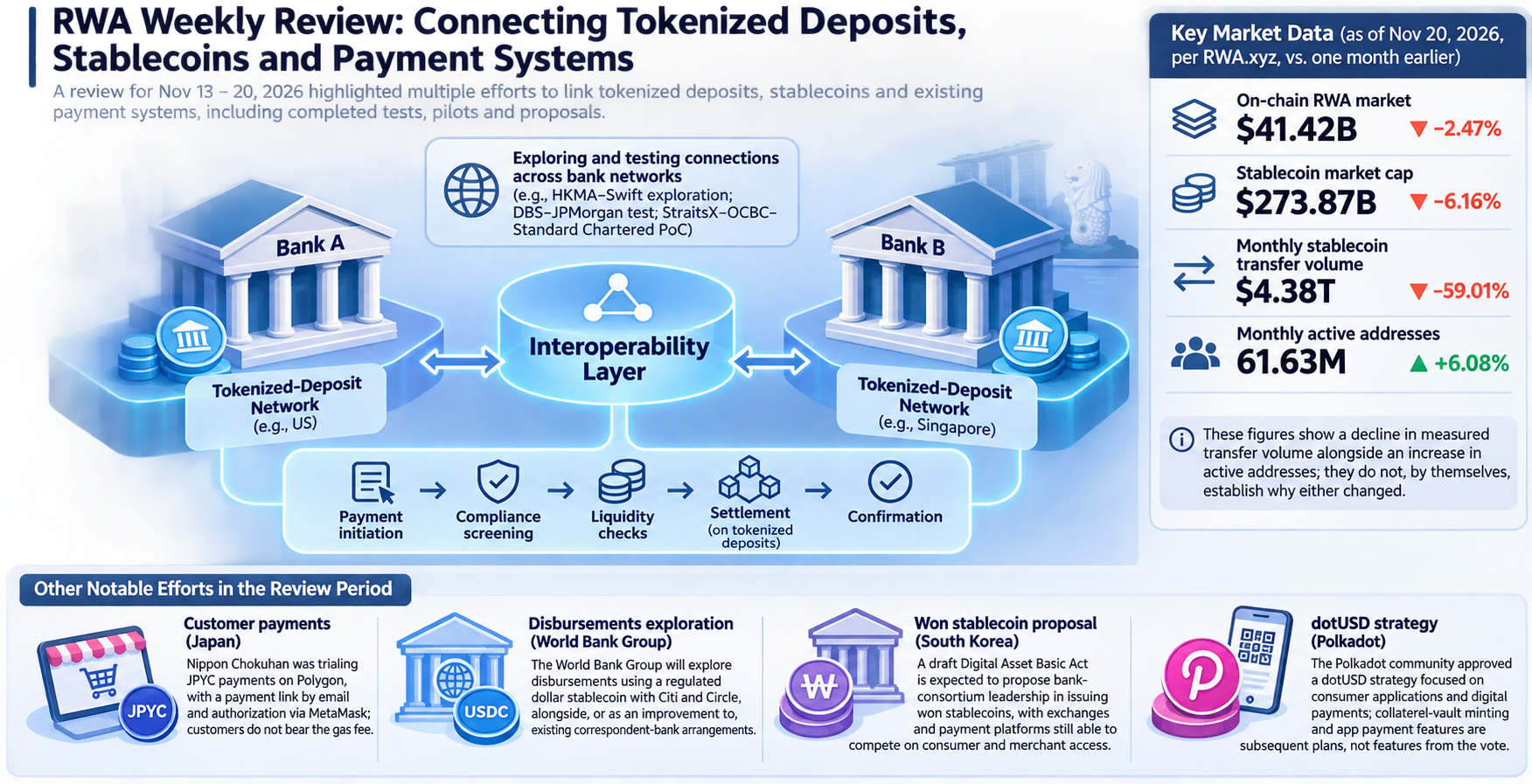
RWA.xyz data cited in the review put the on-chain RWA market at $41.42 billion as of November 20, down 2.47% from the same point a month earlier. Stablecoin market capitalization was $273.87 billion, down 6.16% on the same basis. Monthly stablecoin transfer volume fell 59.01% to $4.38 trillion, while monthly active addresses rose 6.08% to 61.63 million. Those figures show a decline in measured transfer volume alongside an increase in active addresses; they do not, by themselves, establish why either changed.
Connecting bank deposit networks
The Hong Kong Monetary Authority said on November 16 that it was working with Swift and banks, including Bank of China (Hong Kong), Standard Chartered Bank (Hong Kong) and HSBC, to explore interoperability between the Swift ledger and the settlement layer of its Ensemble project. The focus is multi-currency tokenized deposits for cross-border payments, not an announced live payment service.
Two other efforts were further along in testing. DBS and JPMorgan’s Kinexys introduced a solution intended to let institutional clients transfer US dollars between their blockchain deposit-account networks in the US and Singapore outside conventional banking hours. Separately, StraitsX, OCBC and Standard Chartered completed a proof of concept under Singapore’s BLOOM initiative. Its controlled test covered payment initiation, compliance screening, liquidity checks, settlement and confirmation between the banks’ tokenized-deposit systems. The participants said legal, regulatory, operational and commercial arrangements still need assessment before implementation.
Ant International also reported a pilot with DBS and Franklin Templeton using its Whale orchestration protocol to connect DBS Treasury Tokens with a tokenized money-market-fund arrangement. Its stated aim is delivery-versus-payment settlement between tokenized deposits and fund interests.
Customer-facing payments and disbursements
Japanese retailer Nippon Chokuhan was trialing JPYC payments on Polygon on its own shopping site. A customer selecting token payment receives a payment link by email and authorizes it through MetaMask; the report says the customer does not bear the payment’s gas fee.

The World Bank Group announced that it would explore disbursements using a regulated dollar stablecoin and blockchain payment channels with Citi and Circle. Citi would connect existing banking channels, while Circle would handle USDC minting and settlement. This was described as an exploration alongside, or an improvement to, existing correspondent-bank arrangements—not a completed replacement.
In South Korea, a draft Digital Asset Basic Act was expected to propose bank-consortium leadership in issuing won stablecoins. Exchanges and payment platforms could still compete to connect consumers and merchants, but the roles and applicable payment obligations were not settled. Polkadot, meanwhile, said its community had approved a dotUSD strategy focused on consumer applications and digital payments; the described collateral-vault minting and app payment features were subsequent plans, not features established by the vote.