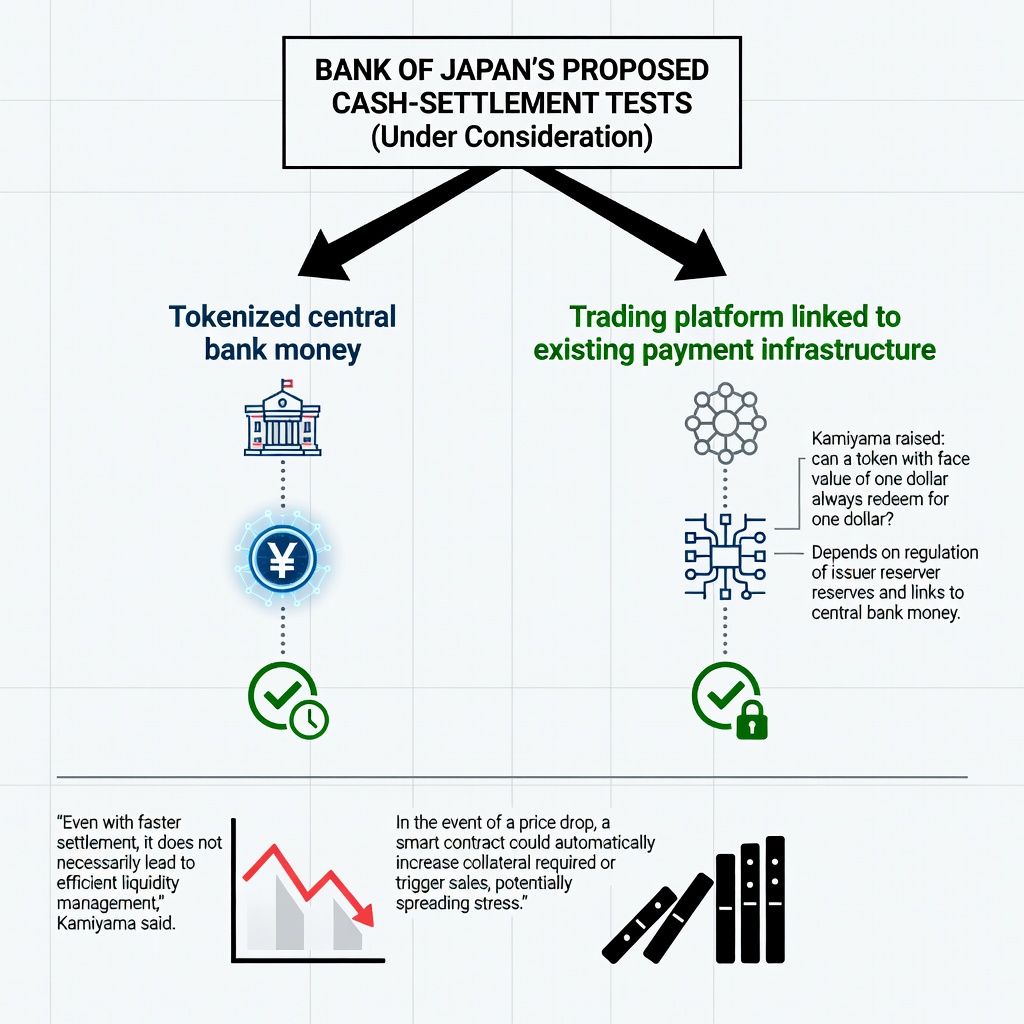
The Bank of Japan was setting up tests of how banks could pay for tokenized Japanese government bonds, according to a report published on November 27, 2026, at 14:50:21 UTC+8. In a keynote at an International Monetary Fund seminar in Tokyo, Kazushige Kamiyama, a Bank of Japan executive director, explained why even a bank with enough cash might be unable to settle an overnight trade.
A token market can stay open around the clock while the payment system a bank uses to move cash is unavailable. The bank might have to keep extra cash on the trading platform because funds on another network are out of reach when payment is due. “Even with faster settlement, it does not necessarily lead to efficient liquidity management,” Kamiyama said.
For the bond tests, the central bank was considering two options: issue tokenized central bank money for the cash payment, or connect the token trading platform to Japan’s existing payment infrastructure. The planned tests, involving financial institutions with accounts at the central bank, would assess whether either approach addresses the difficulties banks face in settling trades.
What smart contracts can change
In a cross-border securities trade, Kamiyama said, a smart contract could link payment to delivery so that cash and the security change hands simultaneously. That would reduce the risk of a buyer paying but not receiving the security.
Automation could also deepen a sell-off. Kamiyama described how a price drop could trigger a smart contract to demand more collateral. If the borrower cannot meet the requirement, the contract could sell the collateral backing the position. Those sales could push prices lower still and spread financial stress across institutions and markets.
Kamiyama raised a separate question for stablecoin payments: can the holder of a token with a face value of one dollar always redeem it for one dollar? He said redemption at face value depends on proper regulation of issuer reserves and reliable links to central bank money.